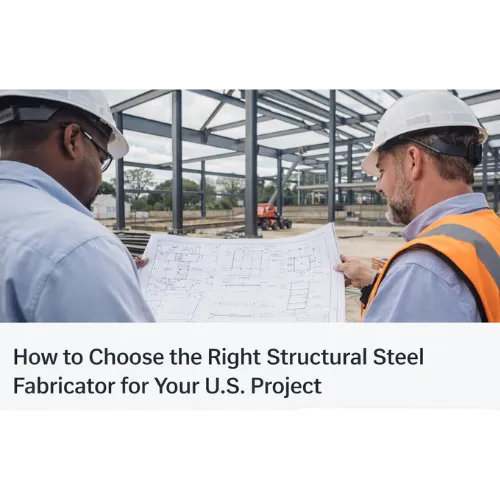
How to Choose the Right Structural Steel Fabricator for Your U.S. Project
“Quality is never an accident; it is always the result of intelligent effort.” - John Ruskin
Selecting the right structural steel fabricator can determine whether your project stays on schedule — or experiences costly delays, rework, and compliance issues.
In the U.S. construction market, where labor, logistics, and material costs are tightly managed, choosing a qualified fabrication partner is not just a purchasing decision. It’s a risk management decision.
This guide outlines exactly what contractors, developers, and engineers should evaluate before issuing an RFQ.
1. Verify AISC Certification and Compliance Standards
For most commercial and industrial projects in the U.S., AISC certification is non-negotiable.
A qualified fabricator should meet or exceed:
AISC Certification
AWS welding standards
ASTM material specifications
OSHA compliance requirements
Project-specific state or federal regulations
If a fabricator cannot clearly document compliance processes and QA/QC systems, you are assuming unnecessary project risk.
2. Evaluate Production Capacity and Lead Times
Fabrication capability must align with your project scale.
Ask:
What is their monthly tonnage capacity?
What is their average fabrication lead time?
Can they scale if scope expands?
Do they handle multi-phase delivery schedules?
A reliable partner should provide realistic lead times — not overly optimistic estimates designed to win the job.
3. Assess Engineering & BIM Integration Capabilities
Modern structural steel projects increasingly depend on:
BIM integration
3D modeling coordination
Shop drawing accuracy
Clash detection processes
Fabricators with in-house detailing and BIM coordination reduce costly field adjustments and schedule disruptions.
If your project involves complex geometry, mixed-use development, or industrial systems, this becomes critical.
4. Review Quality Control & Inspection Procedures
Ask about:
Material traceability systems
Welding inspection protocols
Third-party inspection coordination
Documentation procedures
Strong QA/QC systems protect you during audits and inspections — particularly for government or infrastructure projects.
5. Examine Logistics & Delivery Capabilities
Fabrication is only part of the equation.
A strong fabricator should have:
Coordinated delivery schedules
Proper packaging and labeling systems
Experience with multi-state shipping
On-time delivery track record
Delays in steel delivery can cascade into lost labor hours and equipment downtime.
6. Request Project Experience in Your Sector
Different sectors require different expertise:
Commercial office buildings
Industrial facilities
Warehousing & logistics
Infrastructure
Energy & utilities
A fabricator experienced in similar project types will anticipate challenges before they become delays.
7. Understand Pricing Structure & Cost Drivers
Low pricing can signal:
Limited capacity
Outsourced processes
Thin QA oversight
Instead of focusing solely on cost per ton, evaluate:
Fabrication complexity
Surface treatment requirements
Delivery coordination
Compliance documentation
Value and reliability outweigh marginal cost savings.
What We Need to Provide an Accurate Quote
To prepare a detailed fabrication estimate, most structural steel projects require:
Project location
Estimated tonnage
Required specifications (AISC class, coatings, etc.)
Delivery timeline
Shop drawings or design documents (if available)
Providing this information upfront speeds up the quoting process and improves accuracy.
Planning a U.S. Structural Steel Project?
If you’re evaluating fabrication partners for an upcoming commercial, industrial, or infrastructure project, our team can review your specifications and provide a detailed estimate.
We support U.S. contractors with:
AISC-compliant fabrication
Quality-controlled production
Reliable lead times
Multi-state logistics coordination
Engineering and detailing support
Request a Structural Steel Fabrication Quote
Submit your project details and receive a professional review from our engineering team.
Typical response time: 24–48 hours
✔ Commercial & industrial projects
✔ Infrastructure & public works
✔ Custom fabrication requirements
✔ Multi-phase delivery scheduling
